Cat scratching the sofa? A comprehensive guide
If your cat scratches the sofa , you're in good company – it's a common problem for cat owners worldwide. Whether it's a fabric sofa or a leather couch, many cats see both as the perfect scratching post. And if your cat never scratches the sofa , why not treat her to an extra treat or some canned food to celebrate? 😉
Instead of simply scolding or resigning yourself to the sofa, a structured look at the behavior can help. In this blog post, we'll tackle the issue of "cat scratching the sofa" with a three-step method:
- Understanding behavior: Why does the cat scratch the sofa?
- Planning measures: How can I specifically prevent scratching on the sofa?
- Adjusting the strategy: Which solution is the perfect fit for our apartment and our cat?
Step 1: Understanding the behavior – why is the cat scratching the sofa?
Before we can "save" the sofa, we need to understand why the cat is scratching it in the first place. The most common causes can be divided into four groups:
- Nail care (nail grinding)
- Physical activity / routine
- Marking & Territorial Behavior
- Stress reduction
1. Claw care – the classic
For many cats, the sofa is simply a substitute for a tree . In nature, cats scratch tree bark to groom their claws and remove loose layers of keratin. Living rooms rarely have trees around – but a sofa with a comfortable surface offers itself as a "tree substitute".
Typical signs:
- Your cat not only scratches the sofa, but also occasionally carpets, door frames, etc.
- The claws are noticeably long; perhaps it's been a while since you trimmed them.
In such cases, scratching is usually an expression of a completely natural need: claw care .
Important: Surgical removal of the claws (claw amputation / "declawing" / onychectomy) is extremely painful, violates animal welfare regulations, and is prohibited in many countries. It is never an acceptable solution.
2. “Exercise program” – Scratching as a habit and training
Cats are creatures of habit. Once they start scratching the sofa, it can turn into a kind of daily mini-workout: stretching, extending, using their claws – a short fitness moment.
Characteristics of this:
- The claws are not particularly long ; perhaps they were recently trimmed.
- The cat scratches the sofa relatively regularly, without any other factors being apparent.
- It seems more ritualized than panicked or over-the-top.
Then the scratching has probably become a ingrained routine – a behavior that can be redirected with suitable alternatives.
3. Marking & territorial demarcation – “This is my place!”
Scratching doesn't just cause superficial damage to the fabric: Cats have scent glands in their paw pads . By scratching, they leave scent marks that clearly signal to other cats: "I've been here – this is my territory."
Typical signs:
- You have several cats in your household.
- Several animals are very interested in the sofa.
- There are tensions surrounding this place, e.g., chasing people away or aggressive behavior.
In such cases, the sofa is not just a piece of furniture, but a valuable resource spot – a contested territory.
4. Stress reduction – using the sofa as a “punching ball”
Cats are often much more prone to stress than we think. Changes or small everyday things can trigger stress in them. Some react by withdrawing, others by refusing food or showing physical symptoms – and still others scratch the sofa.
Typical stressors can include:
- Moving, renovation, new furniture
- New person or new animal in the household
- Visitors, noise, unfamiliar smells
- Negative experiences with other cats (e.g., fights, food disputes)
In addition, there is stress caused by us humans :
- The cat is held against its will for a long time.
- She is regularly picked up, even though she doesn't like it at all.
- She is being carried in a position that is uncomfortable for her.
- Parts of her body that she cannot tolerate are touched (belly, rear end, paws).
Many cats then look for an object on which to release tension. The sofa becomes their "stress release valve" at that moment.
The “5-minute rule” for stress analysis
To identify stress as the cause, it helps to ask yourself each time:
What happened in the last 5 minutes before the cat scratched the sofa?
- Did you just pick her up even though she was trying to resist?
- Was there a fight between two cats (eye contact, growling, chasing each other away)?
- Did you brush her, give her medication, or trim her claws?
If you recognize a pattern, that's a strong indication that stress is the trigger .


Step 2: How do I prevent the cat from scratching the sofa?
After step 1, we know what the likely main cause is for your cat: claw maintenance, training, marking, or stress. This allows us to derive targeted measures.
2.1 Claw care & redirecting the “workout” – offering scratching opportunities
Cats need to scratch . The goal is therefore not to stop them from scratching, but to redirect it to suitable surfaces .
Possible alternatives:
- Scratching board (horizontal or vertical)
- scratching post
- Sisal mats
- Cardboard scratching trays
- Columns with sisal rope
- Robust carpet remnants
A common mistake: placing a scratching board "just anywhere" in the apartment. If the cat has learned that the sofa is the ideal scratching spot, it needs to be retrained .
Method 1: Place the scratching board directly next to the sofa.
Place or attach the scratching board directly to the areas of the sofa where your cat prefers to scratch: on the side, in front, or on the armrest. This way, her routine remains the same; only the material changes.
Method 2: Transparent tape + scratching board – gentle redirection
Proceed:
- Prepare the adhesive tape: Attach the transparent adhesive tape so that the sticky side faces outwards.
- Attach it to the sofa: Stick adhesive tape to the areas where the cat usually scratches. The feeling on the paws is unpleasant, making the area unattractive.
- Place a scratching board next to it: Position a scratching board directly next to the area covered with adhesive. When the cat tries to scratch, it will hit the board instead of the fabric.
- Be consistent: Maintain the combination of adhesive tape and scratching board until the new behavior is stable.
2.2 Marking & Territorial Behavior – Creating Attractive Alternative Spots
If the cat scratches the sofa because it considers the spot particularly valuable and is marking it as territory, a single scratching post is usually not enough. The goal here is to create more attractive scratching spots so that competition for the sofa decreases.
Offer more "relaxation and wellness areas".
Ask yourself: Are there perhaps too few truly comfortable, cat-friendly spots in the apartment?
Solutions:
- Additional cat beds or cozy caves
- Hammocks or lounging areas on the cat tree
- Window sills with padded support
- Blankets, pillows or seat cushions in quiet corners
It is particularly helpful to choose materials that are similar to the sofa – especially if your cat clearly loves a particular surface.
Every cat has its own preferences: some like linen, others cardboard boxes, still others fleece, plush, or classic cotton blankets. A little experimentation is required here.
"Golden rule" for multi-cat households
A helpful guideline: Number of resting places ≈ 2 × number of cats
- 1 cat → at least 2 attractive resting places
- 2 cats → at least 4 resting places
- 3 cats → at least 6 resting places
The more equally valuable spots there are, the less pressure there is to defend or mark that one particular sofa – and the less the cat will scratch the sofa to signal territorial claims.
2.3 Stress reduction – taking the causes seriously, not just the symptom
If stress is the main cause, simply placing a scratching post next to the scratching post isn't enough. You need to address the underlying triggers .
Stress caused by people – typical pitfalls
Ask yourself honestly if you frequently do any of the following:
- You hold your cat for longer than usual, even though it clearly wants to get free.
- You regularly pick her up, even though she doesn't like it at all.
- You are carrying her in a position that is uncomfortable for her.
- You are touching her in places she doesn't tolerate (belly, rear end, paws).
The goal should be to consciously reduce these actions and pay more attention to the cat's body language.
Stress caused by other cats – recognizing social tensions
In multi-cat households, stress often arises from negative or forced interactions :
- A new cat moves in, and the "old cat" doesn't get enough time to get used to it.
- Feeding areas are too close together, resulting in competition for food.
- There are too few resources: sleeping places, elevated spots, places to retreat to, toilets.
Create your personal stress list
Whenever your cat scratches the sofa , mentally replay the last five minutes:
- What exactly happened?
- Who was involved (you, other people, other cats)?
- Was there an action that might have triggered the scratching?
Write these situations down. Over time, you'll create a personal stress list for your cat. Avoid these triggers, adjust your behavior, and support your cat with safe havens and a routine.
Step 3: Find the right strategy for your household
After the first two steps, you know the likely cause and have a toolbox of possible measures . Now it's about creating an individual solution for your cat.
No 100% standard solution
The important thing to remember is that there isn't one single method that works for all cats. The underlying logic remains the same – the specific implementation varies from cat to cat.
Examples:
- Your cat scratches because she needs to groom her claws, but she hates classic scratching boards – instead she loves cardboard boxes or a tall scratching post.
- If she prefers sisal, carpet or certain fabrics – then use these materials specifically.
Then the rule is: Don't focus on the product, but on the principle. If cardboard is your favorite material, use cardboard solutions – as long as they are safe.
Creative alternatives – yes, but with brains
Some cats like unusual things, such as special doormats or other animal products. Such experiments can work – but:
- Make sure the material is safe .
- If your cat likes to chew on such mats, it can lead to vomiting or intestinal problems.
- When in doubt, it's best to use safe, proven cat products.
The basic idea remains: Within the same logic (claw care, training, territory, stress reduction) you can try many different "tools" until you find what suits your cat.
Conclusion: From frustration to understanding – when the cat scratches the sofa
When the cat scratches the sofa , it's initially annoying – but there's almost always a clearly understandable need behind it:
- Claws need to be cared for.
- The body wants to stretch and move.
- Territories must be marked and defended.
- Stress has to be released somewhere.
Using the three-step method:
- Analyze the causes (claw care, training, marking, stress)
- Take targeted measures : Properly place scratching alternatives, make the sofa unattractive, create more resting places, identify and reduce stressors.
- Adapt your strategy and cater to your cat's individual preferences
“My cat is scratching the sofa, I’m going crazy” becomes more like: “I understand why she’s doing that – and I know which levers I can pull.”
This way you not only protect your sofa, but also actively do something for the quality of life and well-being of your cat.
Explore more
Share this
Popular Articles


Thank you for reading this far – it really means a lot to us! We hope you found something useful and maybe your cat is already looking forward to a little something extra. See you soon and lots of purrs!
By the way
Many cat owners pay close attention to the ingredients in their cat's main food , but often forget about treats .
Snacks often contain sugar, grains and artificial additives that can be harmful to health in the long run.
Anyone who truly wants to feed their cat a completely healthy diet should also rely on natural ingredients here:
Hypoallergenic treats without additives – naturally from RumbleBox. Perfect as a reward, during training, or simply as a snack.
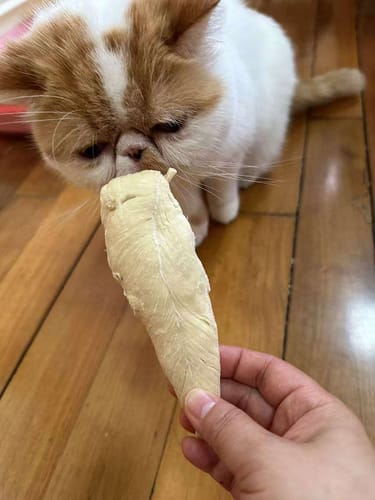
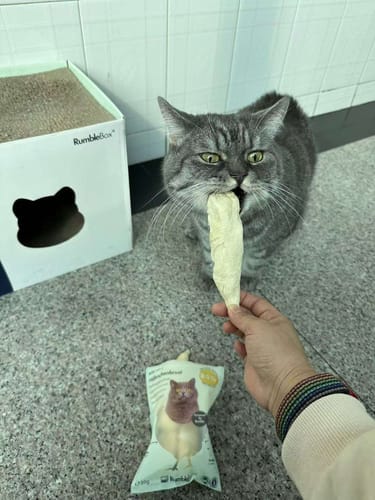
Over 2,500 cats have already switched to healthy snacks!
💚


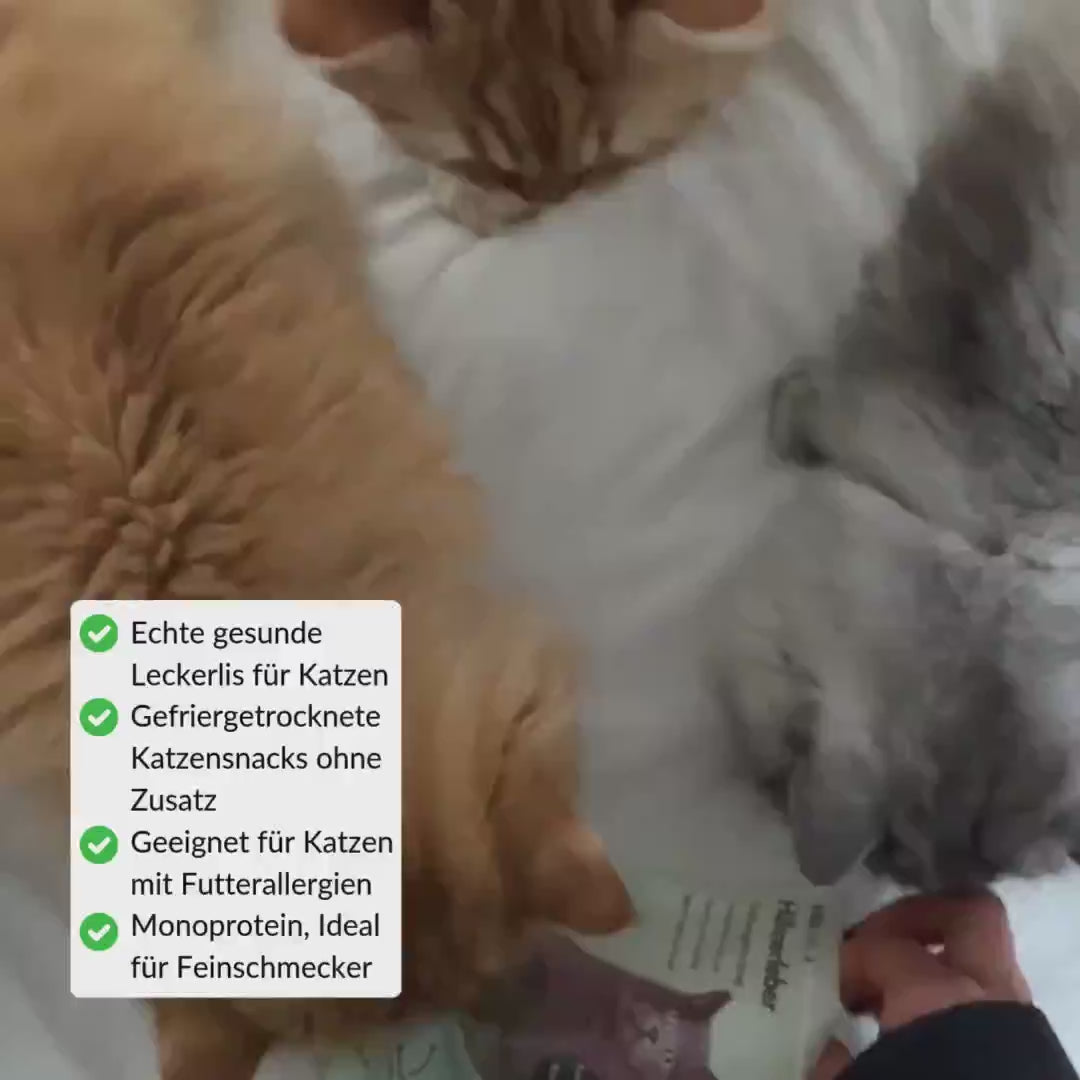


100% Duck Breast Monoprotein 50g
composition
Description
FREEZE-DRIED CAT SNACKS: 100% DUCK BREAST – NATURAL & NUTRITIOUS
Our freeze-dried cat snacks made from 100% duck breast are the perfect choice for cats who love pure meat snacks. The extra-large pieces are ideal for cats who like to bite hard—at the same time, they encourage their natural chewing instinct and support dental care.
Whether as a daily reward, monoprotein treat for cats or high-quality dried duck breast for cats with special needs – this freeze-dried cat snack stands for species-appropriate nutrition without compromise.
WHY OUR DUCK BREAST SNACKS ARE CONVINCING
- 100% natural : Pure duck breast – no grains, sugar or additives.
- Large pieces for extra enjoyment : Each duck breast is approx. 10 cm long, ideal for enjoyable chewing.
- Fresh meat : Direct from the farm – each 50g pack contains approximately 250g of fresh duck breast.
- Rich in nutrients : High-quality protein and valuable fatty acids for a shiny coat and strong muscles.
- Healthy teeth : The solid pieces promote chewing and support dental care.
- Monoprotein and well tolerated : Unprocessed duck breast for a healthy, species-appropriate diet.
PERFECT FOR ALLERGIC CATS AND SPECIAL NEEDS
Our freeze-dried cat snacks are not only delicious but also extremely well-tolerated. They are ideal as healthy treats for cats or as food for cats with allergies.