Eosinophilic granuloma in cats: An overview of causes, symptoms, diagnosis & treatment
Eosinophilic Granuloma in Cats: When the skin reacts to something you don't see
A thick lower lip overnight. A red, weeping patch on the belly that the cat is licking until it bleeds. A ridge-like line on the inside of the hind leg that feels like a thin pencil under the skin. Anyone seeing this for the first time might think of a tumor – and will almost always be wrong. In most cases, an eosinophilic granuloma in cats is the culprit, or more precisely, the eosinophilic granuloma complex. Sounds like a standalone disease. But it isn't. And that is exactly the point that most owners don't grasp until their second or third visit to the vet.
I am writing this post because the topic is treated either in a clinically dry or a reassuringly superficial manner online. Neither helps when you are sitting there with a cat that has been scratching at its lip for weeks. This is about what really matters: what triggers the whole thing, why "cure" is the wrong word – and where nutrition can actually make a difference.
What is eosinophilic granuloma in cats? Definition and classification
The eosinophilic granuloma complex (EGC) explained simply
The word "complex" here is not marketing, but an indication that it is a group of skin reactions that can occur together. The MSD Veterinary Manual puts it soberly: Eosinophilic skin changes are "not diseases per se, but clinical signs" (MSD Veterinary Manual). This is the sentence you should remember. The cat does not have an "eosinophilic granuloma" as it would have a broken paw. It shows a reaction pattern – the skin responds to some stimulus with the same repertoire every time.
It is interesting that grouping the three forms under one umbrella is controversial even among dermatologists. William H. Miller Jr., a dermatology professor at Cornell University, states it openly: the grouping is "questionable" because only one of the three forms actually forms a true granuloma. Nevertheless, they should remain together – "because all three show the activity of eosinophils and have an obvious allergic trigger as a causative event" (Cornell Feline Health Center). The fact that experts disagree here is not a detail for know-it-alls. It explains why your vet might talk about "EGC" and the next one about "feline hypersensitivity syndrome".
What role do eosinophilic granulocytes play?
Eosinophils are white blood cells that the body actually deploys against parasites. According to Cornell, what happens in EGC is the insidious part: these cells release their inflammatory messengers "to defend against the invasion of parasites, even though no such invasion has taken place." The result is the classic signs of allergy – itching, swelling, inflammation. The skin is fighting an enemy that isn't there. Or more precisely: an enemy that is so small (a single drop of flea saliva) that the reaction seems completely over the top.
The three forms of the eosinophilic granuloma complex
Eosinophilic granuloma – chin, lips, legs
This is the most common of the three forms and at the same time the only one that deserves its name. The MSD manual describes firm nodules in the skin that are considered true granulomas. Two appearances are seen very often in everyday life: the so-called fat chin – a swollen chin and lip area, typical of flea bite hypersensitivity – and the linear granuloma, those pencil-like, often bilateral thickenings on the back of the thighs. Interesting side note from MSD: the linear granuloma has become rarer in the USA, "presumably due to the widespread use of flea prophylaxis." This is basically indirect proof of how closely fleas and EGC are linked.
Eosinophilic plaque
This is where it gets unpleasant. According to MSD, the eosinophilic plaque is an "intensely pruritic, weeping lesion" and is caused by self-trauma – the cat licks and scratches the spot raw itself. Cornell vividly describes them as "red, angry wheals," usually on the belly or thighs. Anyone who has ever had a cat that licked a palm-sized, moist, hairless area on its belly knows the look. Often a secondary bacterial infection occurs, which is why MSD recommends antimicrobial therapy based on pathogen and susceptibility testing as the first step for this form – not just blindly prescribing cortisone.
Indolent ulcer (Rodent ulcer, lip ulcer)
The indolent ulcer – also called "rodent ulcer" – is almost always located on the upper lip, often bilaterally on the philtrum, that small groove under the nose. Well-defined, erosive to ulcerative, sometimes with raised edges. MSD typically classifies it as an allergic skin disease, "especially flea bite hypersensitivity," but notes that trauma can also be the cause. Important, and honestly the reason why you should not tinker around yourself for too long with this form: if the ulcer occurs only unilaterally or behaves unusually aggressively, a neoplasia – i.e., cancer – must be ruled out through differential diagnosis. This is not scaremongering, that's what the manual says.
Recognizing symptoms: How eosinophilic granuloma shows in the cat
Typical skin changes, itching, and affected areas
Cornell summarizes the range well: "weeping masses, yellowish-pink ulcers, or large tumor-like lumps." The locations are tell-tale. Chin and lips, belly, inside of thighs, sometimes the ears. Incidentally, the latter are a classic sign of mosquito bite hypersensitivity – MSD calls ear lesions typical for cats that react to mosquito bites. So if the change occurs seasonally in summer and the cat goes out at night, you have, according to Dr. Miller from Cornell, "guessed the cause pretty well."
The itchiness varies greatly. The granuloma itself often itches surprisingly little. The plaque, on the other hand, almost drives the cat crazy. This discrepancy regularly confuses owners because they expect "skin problem" to mean "scratching."
Warning signs that mean you should go to the vet
Cornell describes a case that stuck with me: if a lesion is on the back of the head, a cat can "scratch the skin raw within hours – and the wound then becomes very nasty very quickly." That is the moment not to wait until the next working day. The same applies to unilateral, rapidly growing, or destructive lip changes, lesions in the mouth that interfere with eating, or if nothing gets better after two or three weeks. Some EGC lesions do disappear spontaneously – but betting on that while a secondary infection takes hold on the side is not a strategy.
Causes and triggers of eosinophilic granuloma
Allergies as the main trigger
If you take one thing from this article, let it be this: EGC is almost always an allergy problem. MSD names the "hypersensitivity reaction to an allergen – insect, environmental, adverse food reaction" as the most frequent underlying cause. And among the allergens, one leads by a wide margin: flea saliva. Flea bite hypersensitivity appears in both sources, MSD and Cornell, again and again as the front-runner. After that come environmental allergies (atopic dermatitis) and food allergies. Pollen, house dust mites, certain proteins in the food – the list of possible triggers is long, and that makes searching for the cause so arduous.
Genetic predisposition
The pet owner version of the Merck/MSD manual explicitly mentions "genetic or hereditary factors" as a possible background in addition to allergies and infections (Merck Veterinary Manual). In plain language: some cats are simply more susceptible. This explains why two cats in the same household, with the same fleas and the same food, can react completely differently – one scratches until it bleeds, the other remains unimpressed.
Infections and autoimmune reactions
Less common, but documented: viral, bacterial, and fungal infections as well as autoimmune events can trigger the same reaction pattern. Cornell also mentions systemic reactions to substances such as antibiotics or heart medications. That is why EGC is so unrewarding diagnostically – the visible result is always similar, the path to it highly different.
Rarer triggers like trauma
With the indolent ulcer, MSD points out that a simple mechanical irritation or inflammation – a trauma – can also cause the lesion. This is the exception, not the rule, but it explains individual cases in which absolutely no allergen can be found.
Diagnosis: The path to the right cause
Veterinary examination, cytology, and histopathology
Diagnosis rarely begins with a scalpel. For the eosinophilic ulcer, MSD lists trichogram (hair analysis, e.g., for Demodex mites), impression smear, Wood's lamp, and, if necessary, a fungal culture. In the case of plaque, cytology typically shows eosinophilic and neutrophil cells. A biopsy for histopathology is, according to MSD, then necessary "if there is no response to appropriate treatment or the lesion appears suddenly and is destructive." Specialized veterinary labs like Laboklin offer exactly such cyto- and histopathological examinations – so the path often leads through the lab.
Exclusion of other diseases (differential diagnoses)
This is the real crux of the matter. Because EGC is a reaction pattern, one must rule out what else looks like it: neoplasia, pyoderma, fungal infections, autoimmune dermatoses. Cornell emphasizes the thorough check for external parasites – sometimes the answer is banal and resides in the fur.
Allergy tests and the importance of searching for the cause
MSD is clear here: in cats with recurring lesions, a feline hypersensitivity syndrome may be present, and "a test for environmental allergens and/or a food test" may be indicated. Exactly this food test – the exclusion diet – is the part that owners contribute significantly to at home. More on that in a moment.
Treatment of eosinophilic granuloma
Symptomatic therapy: Corticosteroids
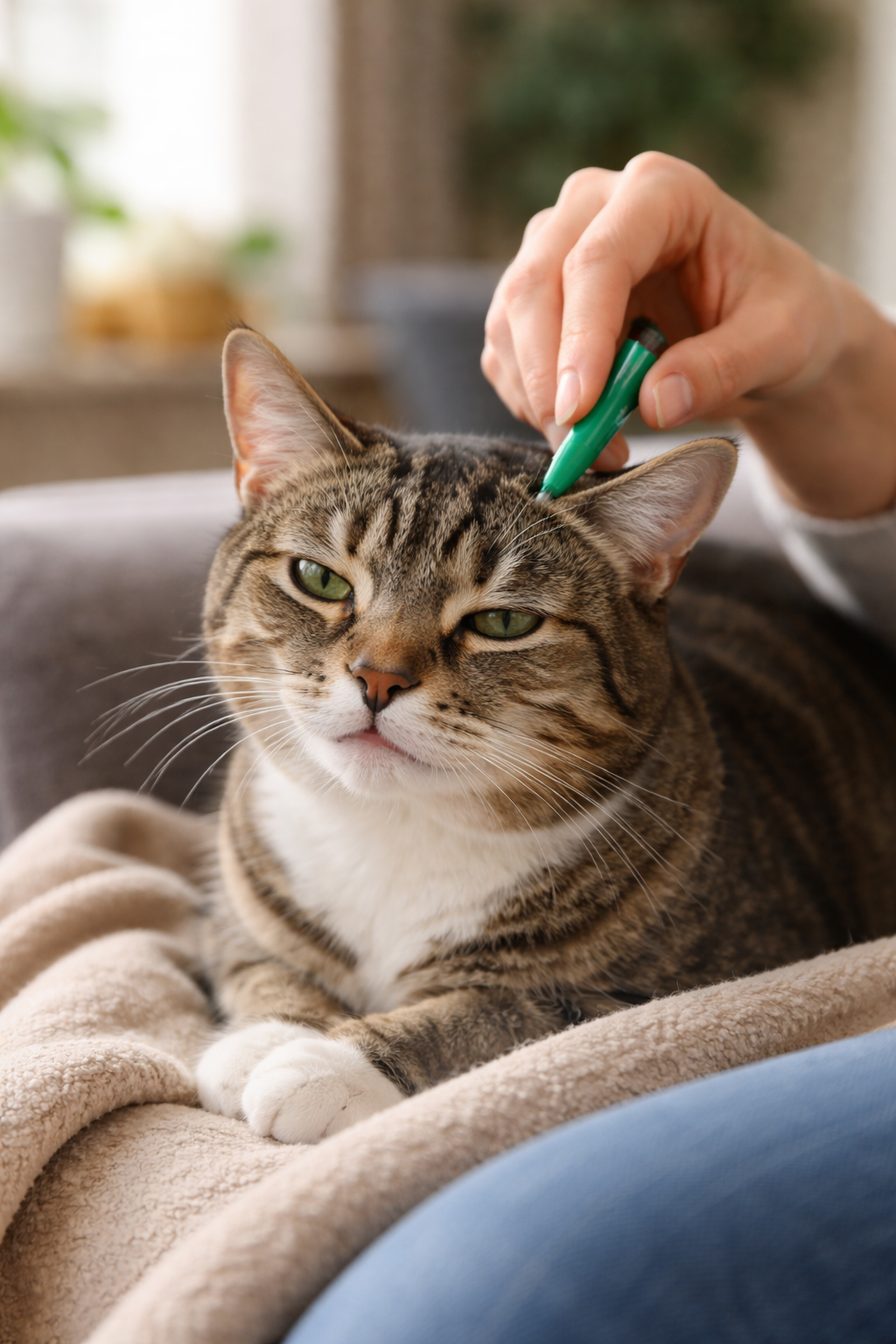
If aggressive flea control and antimicrobial therapy are not enough, corticosteroids come into play. MSD specifically mentions anti-inflammatory dosages of prednisolone (1–2 mg/kg orally every 24 hours until healing) or triamcinolone. Important to know: healing "can take several weeks." Cortisone here is symptom control, not a fix for the cause. It reduces the inflammation – but if the flea saliva or food protein continues to arrive, the problem comes back.
Treatment of the underlying cause
That is the part that really decides everything. MSD formulates a simple, almost old-fashioned sequence: thorough flea prophylaxis, "started and maintained over 2–4 months." Four months. Not two weeks until it looks better. For eosinophilic granuloma, according to MSD, it simply applies: "The lesions heal when the underlying trigger is treated." Sounds unspectacular, but is the whole trick.
Further therapies for stubborn cases
If no trigger can be found – which is rare but happens – modified cyclosporine (in the feline formulation, orally, 7 mg/kg every 24 hours) can help, according to MSD. Cyclosporine (brand name Atopica) and the JAK inhibitor oclacitinib belong to the extended toolkit of veterinary dermatology. But that belongs in the hands of a vet or dermatologist, not in self-medication. Those who want to delve deeper into feline dermatology will find reliable literature from specialist publishers like Thieme and in the trade press via Vetline.
Focus on food allergy: The exclusion diet step-by-step
Selection of a mono-protein or hydrolyzed diet
If fleas and the environment are ruled out and the lesions remain, you end up with the elimination diet. The principle: for weeks, you feed exclusively one protein source that the cat has never had before (a "novel" protein source), or a hydrolyzed diet where the protein is broken down so small that the immune system no longer recognizes it. Both only work if you carry them through uncompromisingly.
Duration, strict adherence, and provocation test
And this is exactly where most attempts fail – not because of the food, but because of the treat in between. An exclusion diet typically runs for several weeks, and a single "wrong" snack can falsify the result. The decisive step at the end is the provocation: you feed the original food again and watch to see if the symptoms return. If they do, the proof is provided. This clean provocation is what distinguishes a real diagnosis from "it's getting better somehow."
Suitable snacks during the diet
This is where it gets practical – and where RumbleBox comes into play, honestly and without whitewashing. The problem with commercial treats during an exclusion diet is the list of ingredients: grains, sugar, binders, several types of meat, artificial colors, and preservatives. Any of these components can trigger a reaction and ruin the test.
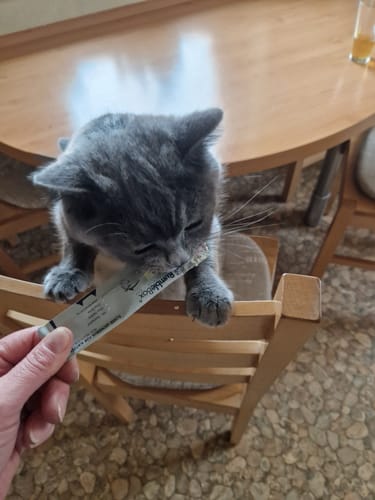
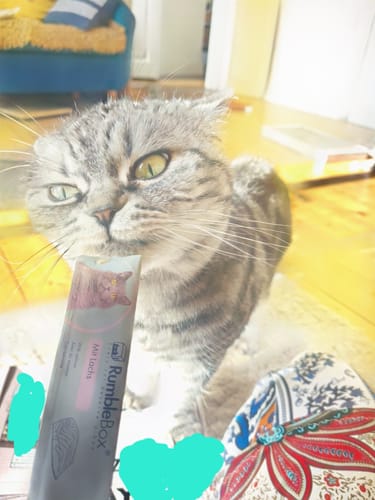
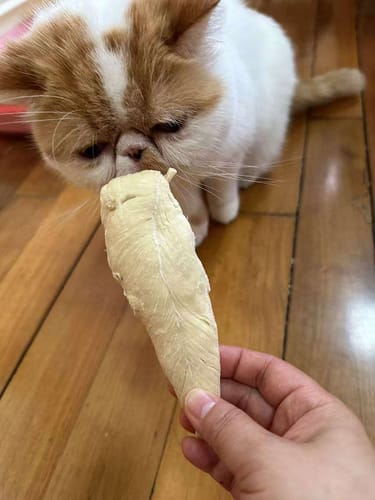
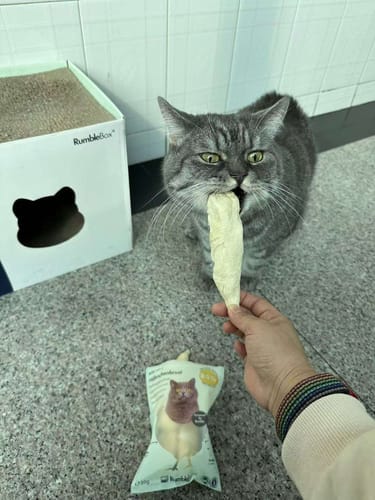
RumbleBox consciously focuses on the opposite. The freeze-dried monoprotein snacks consist of exactly one ingredient – e.g., 100% chicken breast, without grains, without sugar, without binders, without artificial colors and preservatives. This is exactly the profile that an elimination diet demands: a single, clearly defined protein source with which you can reward, train, or sweeten the administration of medication without breaking the diet. RumbleBox states that 95% of cats do not react sensitively to the ingredients contained – and the association behind the "Kriticats" reports that over 100 cats have taken their medication more easily with the help of these snacks. Exactly this use case – giving medication to an already stressed EGC cat – is worth its weight in gold in everyday life. You should best clarify with the veterinarian accompanying the exclusion diet which monoprotein variety suits your diet.
Skin, immune system, and gut: The gut-skin connection in cats
How a healthy gut influences the immune system and skin
A large part of the immune system is in the gut – and EGC is, at its core, an immune-mediated event. The connection between gut health and skin appearance is well-studied in human medicine and is increasingly being considered in veterinary medicine. I don't want to oversell anything here: a change in diet does not heal a flea allergy. But an easily digestible, low-irritant diet relieves an already overreactive system and reduces the number of variables with which the skin is confronted.
Species-appropriate, meat-rich diet without grains and sugar
Cats are obligate carnivores. This is not a marketing cliché, but physiology – they need animal protein and struggle with grains and sugar. RumbleBox builds its entire range around this idea: high fresh meat content (up to 70% in the Schleckies), grain- and sugar-free, with taurine and fish oil omega-3 fatty acids, which according to manufacturer specifications support skin and fur. For a sensitive cat with a skin issue, "less is more" – the RumbleBox brand philosophy – is indeed a sensible approach: the shorter and clearer the ingredient list, the fewer potential triggers.
Prevention and long-term management
Consistent flea prophylaxis and allergen avoidance
Cornell formulates the prevention in a refreshingly practical way: keep the cat indoors when mosquitoes and other stinging insects are out, use suitable repellents, and strictly avoid food to which the cat is demonstrably allergic. Add to this the gapless flea prophylaxis – the disappeared linear granuloma in the USA is the best evidence that this works.
Why EGC is managed – not "cured" –
This is the uncomfortable truth you have to come to terms with. A PMC review describes the eosinophilic granuloma complex as a "serious pathology that often requires lifelong treatment" (PMC / NCBI). Because the underlying hypersensitivity remains, it is not about "gone forever," but about reducing relapses: know the triggers, do not slack on flea prevention, avoid the identified allergens, and keep the diet clean. Those who stick to this often have a cat that lives lesion-free for years – even if the predisposition continues to lie dormant in the background.
Frequently Asked Questions (FAQ) about Eosinophilic Granuloma in Cats
Is eosinophilic granuloma in cats contagious?
No. It is an immune-mediated reaction to a stimulus – usually an allergen – not a transmissible infection. Other cats in the household will not catch it, but they may develop their own lesions independently if exposed to the same allergen burden (e.g., fleas).
Does EGC disappear on its own?
According to Cornell, individual lesions can heal spontaneously. You should not rely on this – itching, self-trauma, and secondary infections are risks as long as the trigger is active.
Can I cure an eosinophilic granuloma with food?
Only if a food allergy is truly the trigger – then the right diet eliminates the cause. In cases of flea or environmental allergies, a low-irritant diet provides support but does not replace flea protection and veterinary therapy.
Which treats are allowed during an elimination diet?
Ideally, pure single-protein snacks without grain, sugar, or additives, tailored to the protein source used in the diet – such as the freeze-dried single-ingredient snacks from RumbleBox. Coordinate with your attending veterinarian beforehand.
How long does treatment take?
According to the MSD, flea prophylaxis should be consistently maintained for 2–4 months, and healing under cortisone may take several weeks. Management is often lifelong.
Further and Trustworthy Sources
- MSD Veterinary Manual – Eosinophilic Skin Diseases in Cats (Karen A. Moriello, DVM, DACVD; as of Jan. 2025)
- Cornell Feline Health Center – Eosinophilic Granuloma Complex
- PMC/NCBI – Some aspects of the diagnosis and treatment of eosinophilic granuloma complex in cats
- Buckley L, Nuttall T. Feline eosinophilic granuloma complex(ities): some clinical clarification. J Feline Med Surg. 2012;14(7):471-481.
- Laboklin – Veterinary Diagnostics (cytology, histopathology, allergy tests)
- Specialist literature on feline dermatology via Thieme and Vetline
This article does not replace a veterinary examination. If you notice skin lesions that are unilateral, rapidly growing, bleeding, or persistent, your cat needs to be in expert hands – ideally with a veterinarian specializing in dermatology.

Thank you for reading this far – it really means a lot to us! We hope you found something useful and maybe your cat is already looking forward to a little something extra. See you soon and lots of purrs!
By the way
Many cat owners pay close attention to the ingredients in their cat's main food , but often forget about treats .
Snacks often contain sugar, grains and artificial additives that can be harmful to health in the long run.
Anyone who truly wants to feed their cat a completely healthy diet should also rely on natural ingredients here:
Hypoallergenic treats without additives – naturally from RumbleBox. Perfect as a reward, during training, or simply as a snack.
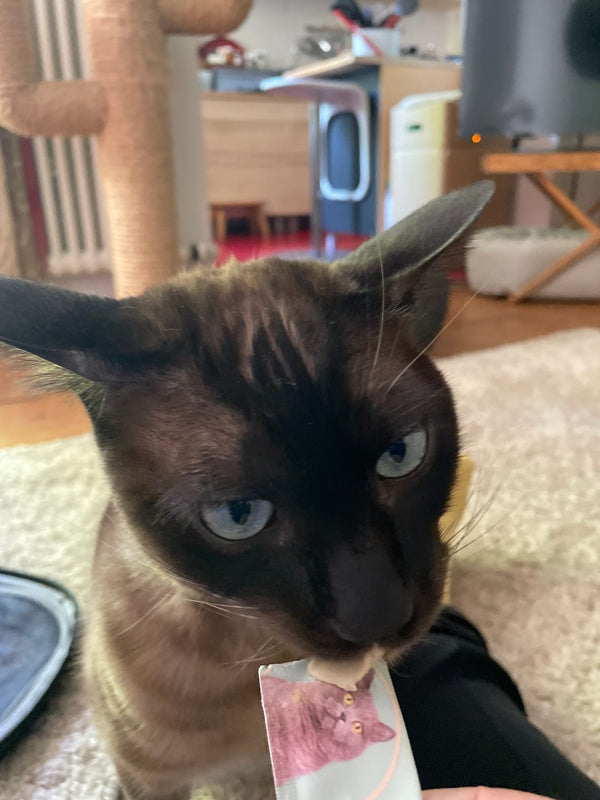
Over 2,500 cats have already switched to healthy snacks!
💚