Blue eyes in cats – causes, genetics & what owners should know
There is this moment that almost every cat person knows: You look into two ice-blue eyes and briefly forget what you actually wanted to say. Blue eyes in cats seem like a little miracle – and that is exactly why animals with this eye color are often hunted, bred, and traded for large sums of money. What very few people know: Behind the blue is not magic, but physics, genetics, and sometimes a health risk that is rarely talked about in online ads.
My professional focus is on cat health and nutrition, and hardly any topic is as romanticized and yet so misunderstood as this one. That is why I am providing an honest overview here – with the facts, the numbers, and what you as an owner really should know before you fall in love with a pair of blue eyes.
Why do cats have blue eyes? The science, briefly and without the fluff
The first surprise: There is no blue pigment in a cat's iris. Not a single one. Blue is created exclusively by the absence of pigment and the way light is scattered in the eye – the same effect that makes the sky appear blue. Melanin, produced by cells called melanocytes, is responsible for the color. A lot of melanin in the iris results in amber, copper, or green. Little to none – and the eye appears blue.
Why all kittens are born with blue eyes
Every kitten is born blue-eyed. Truly every single one. From a litter of a black farm cat just as much as with a fancy breed. The reason is simple: The melanocytes in the iris have not yet started their work at birth. The pigment is simply missing – and without pigment, only the scattered, milky blue remains, which many breeders call "kitten blue."
When the final eye color is determined
From about the sixth to seventh week of life, the melanocytes begin to work. Over the following weeks, the color migrates – often starting with a brownish ring around the pupil that slowly moves outward. The final eye color is usually set between the third and sixth month of life. So, anyone buying an eight-week-old "blue-eyed" kitten may be buying a cat that will have copper-colored eyes at six months old. In some animals, however, the blue remains for a lifetime – specifically when genetics ensure that no significant melanin is ever deposited in the iris.
The genetics behind permanently blue eyes
Eye color is a polygenic trait. Multiple genes are involved, which is exactly why even experienced breeders cannot predict the color of a litter one hundred percent. However, three genetic paths lead particularly often to blue eyes in cats.
The dominant white gene (W)
The best-known mechanism. The dominant white gene, simply called W in professional literature, results in a completely white coat – and in the process, it often suppresses pigment migration into the iris. The result: white cat, blue eyes. The distinction that many confuse is important: A white cat is not the same as an albino cat. In albinism, the pigment is completely absent due to a different genetic reason; most white house cats simply carry the W gene.
The point factor from the old Siamese
In Siamese, Balinese, Birman, or Ragdoll, the blue comes through an entirely different path: temperature-sensitive point coloration. The same genetics that color the mask, ears, and paws dark result in consistently blue eyes – regardless of whether the coat is white. This is why purebred Siamese cats practically always have blue eyes, without any white coat at all.
Heterochromia – when two eye colors meet
Animals with one blue eye and one of another color are called "odd-eyed." This usually happens in white or patched cats when the white gene only "gets" one eye and pigmentation proceeds normally in the other. Visually spectacular – and, as we will see, not medically insignificant.
For those who want to dive deeper: The database OMIA – Online Mendelian Inheritance in Animals documents the genetic traits in animals, and the Veterinary Genetics Laboratory at UC Davis offers concrete genetic tests for coat color and trait determination.
Blue eyes and deafness: the connection that is spoken about too rarely
This is the part that I find most important – and which is missing in most dreamy Instagram posts. The same white gene that provides for a white coat and blue eyes also influences the development of the inner ear. Put simply: The pigment-producing cells are responsible not only for color, but also for a functioning hearing structure in the cochlea. If they are missing, the inner ear can degenerate – the cat is deaf from birth.
What the data actually shows
Caution is advised here, because figures ranging from "50%" to "85%" circulate online, often without a source. Reliable is the assessment from International Cat Care: A white cat with two blue eyes is three to five times more likely to be deaf than a white cat with two non-blue eyes. A cat with only one blue eye has about twice the risk. And long-haired white cats are three times more likely to be bilaterally deaf.
Important for context: The W gene guarantees a white coat, but not necessarily blue eyes or deafness – other genes and factors are involved. In other words: A strong correlation, not an ironclad rule. There are blue-eyed white cats that hear perfectly normally.
The tricky nature of unilateral deafness
In odd-eyed cats, deafness often occurs exactly on the side of the blue eye – and only there. A unilaterally deaf cat is often not even noticeable in everyday life. It reacts to noises, turns its head, and seems completely normal. Only a BAER test (Brainstem Auditory Evoked Response) performed by a specialist shows reliably whether and on which side hearing loss is present. Reputable breeders have white animals tested exactly this way before breeding them.
How to recognize deafness at home
A few everyday signals you can look out for: The cat startles violently when you touch it from behind. It does not react when you call it while it is looking away. It sleeps noticeably deeply and does not react to noise that would cause other animals to startle immediately. Thunder, vacuum cleaners, fireworks – it makes no difference. None of these signs is proof, but together they are a good reason to pay a visit to the vet.
Cat breeds with blue eyes – a realistic overview
The classics: Siamese, Ragdoll, Birman, Balinese, Turkish Angora
Anyone wanting reliable blue eyes ends up almost automatically with the point breeds. The Siamese cat is the prototype – piercing blue eyes, vocal personality, affectionate to demanding. The Ragdoll combines the blue with a strikingly calm temperament. The Birman wears it with white "gloves," the Balinese is basically the long-haired Siamese. The Turkish Angora, in turn, brings blue or odd-eyed eyes via the white gene – here, the deafness check is especially relevant.
Ojos Azules: the rare exception
The Ojos Azules is genetically fascinating because it carries blue eyes independently of coat color – even with dark or tabby fur, without a point factor and without a white coat. However, exactly this mutation brings health risks, which is why the breed is extremely rare and breeding is severely restricted. Finding an Ojos Azules in Germany is practically a stroke of luck – sources like vom-taubertal.de put the life expectancy of healthy animals at about 12–15 years.
Black cat with blue eyes?
This is the rarity constantly searched for online. A solid black cat with permanently deep blue eyes is genetically a true exception – most likely through the Ojos Azules line. Most "black cats with blue eyes" that you see are either very young animals in the "kitten blue" stage or the result of clever photo effects. Skepticism is healthier here than enthusiasm.
What the German market demands
A sober look at platforms like kleinanzeigen.de shows: Point breeds with pedigrees often range in the four-figure price range; "blue eyes" are specifically advertised as a selling point. This exact demand is part of the problem – which we will get to in a moment.
Responsible breeding instead of beauty at any price
I will say it openly: Eye color as the sole breeding goal is a bad breeding goal. Anyone who selectively breeds for the maximum amount of white and blue statistically increases the risk of kittens being born deaf. This is not a matter of taste, but a matter of animal welfare – regulated in Germany by the Animal Welfare Act and the discussion regarding so-called torture breeding.
You can recognize a reputable breeder not by their glossy photos, but by uncomfortable details: They test white animals for deafness via BAER, they talk openly about the genetics in the litter, they do not sell kittens before the twelfth week, and they do not conceal unilateral hearing loss. If someone promises you "guaranteed blue eyes" without saying a word about hearing tests, that is a warning sign. A deaf cat can lead a wonderful life – but it should come into being out of responsibility, not by accident.
Healthy eyes, healthy cat: care & nutrition
You cannot influence eye color. You certainly can influence eye health. And this is where a nutrient comes into play that goes beyond mere kindness for cats: taurine.
Why taurine is so crucial for vision
Cats cannot produce taurine – an essential amino acid – in sufficient quantities themselves. They must ingest it through food. A chronic taurine deficiency in cats is proven to lead to degeneration of the retina (feline central retinal degeneration) and, in the worst case, to blindness – in addition to heart problems. In other words: The most beautiful blue eyes are of little use if there is an under-supplied retina behind them.
Cats are obligate carnivores – and that is not marketing fluff
Taurine is found almost exclusively in animal tissue. That is precisely why a meat-rich, species-appropriate diet is not a trend, but biology. A cat is an obligate carnivore: Its metabolism is designed for animal protein; grains and sugar simply have no place in its natural diet.
RumbleBox tip
For this exact reason, at RumbleBox, we rely on the principle "less is more": snacks with a high content of fresh meat, fresh egg, and fish oil – without sugar, without grains, without unnecessary additives. Our "Schleckies" are additionally enriched with taurine (1,500 mg/kg), which supports exactly the points we are talking about here: vision, a shiny coat, and a stable immune system. The fact that, according to our data, about 95% of cats tolerate the ingredients well makes them a stress-free reward even for sensitive animals. Not a replacement for a balanced main meal – but an honest snack where you know what's inside.
Living with a deaf or blue-eyed cat
If your cat is indeed deaf: This is not a drama, but a few things do change. Letting them roam outside without a secured area is out – a deaf cat cannot hear a car, a dog, or danger. International Cat Care clearly recommends keeping them strictly indoors or in a secured outdoor area.
Communication without hearing
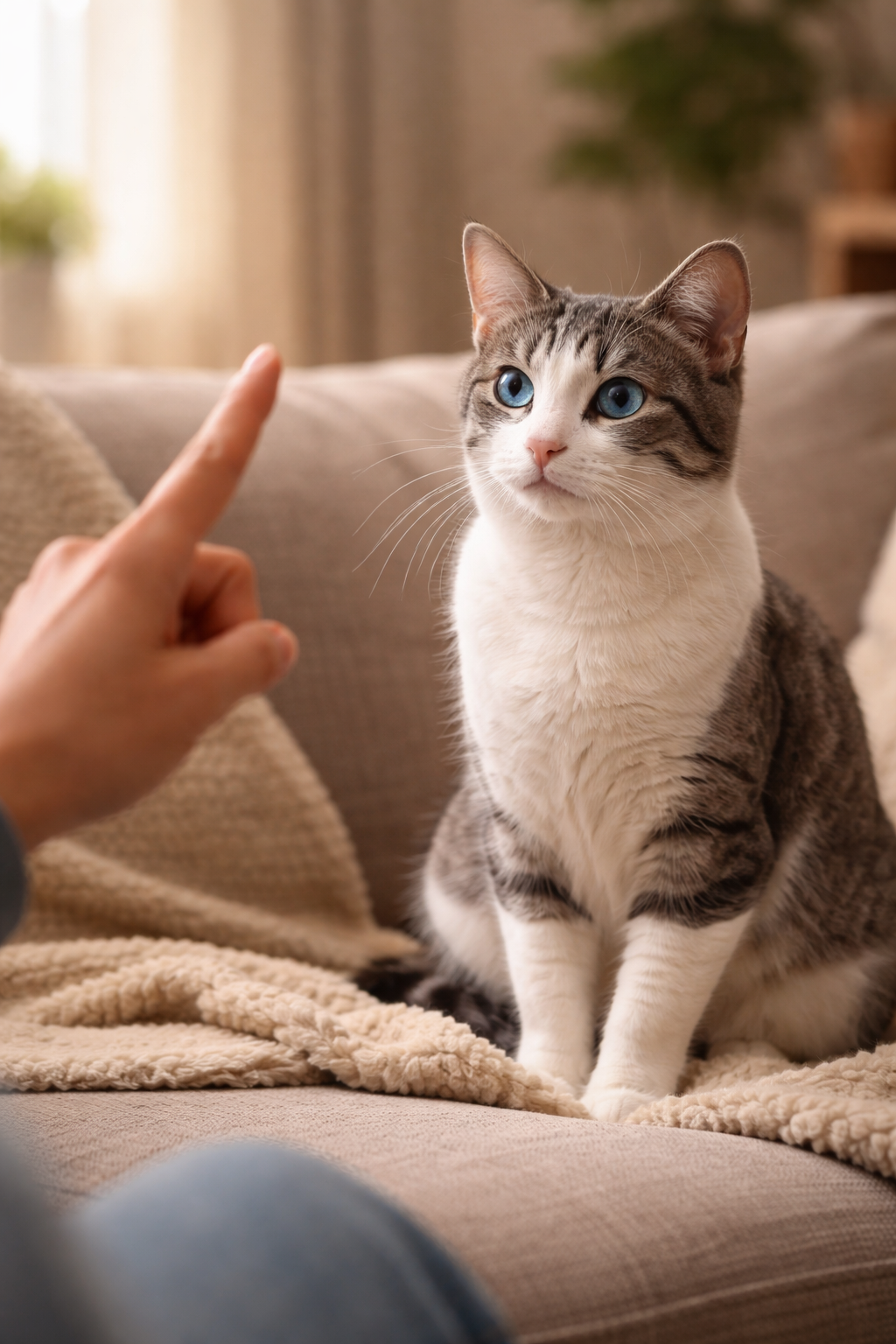
Deaf cats learn surprisingly quickly using vibrations, light, and hand signs. Stamp lightly on the floor instead of calling. Approach from the front so you don't startle them. When waking them up, it is better to touch the pillow next to them than to touch them directly. Many owners develop a little sign language over time – and the bond often becomes even closer because of it.
Reward via the nose, not the ear
This is where an aromatic snack has a practical advantage: Where hearing is missing, the sense of smell takes the lead role. An odor-intensive reward like our freeze-dried chicken breast or the little chicken cubes from RumbleBox is perfect for gaining the attention of a deaf cat and linking visual training with a clear, smellable "Yes, that's right!" These single-protein snacks are intended for exactly these kinds of training and reward moments.
Conclusion: Understanding blue eyes and acting responsibly
Blue eyes in cats are not pigment, but light physics. They arise because melanin is missing in the iris – sometimes temporarily in kittens, sometimes permanently due to the white gene or the point factor. As beautiful as the blue is: It can be an indication of a higher risk of deafness, especially in white cats with two blue eyes. Anyone bringing such an animal into their home should know this, rather than romanticizing it – and support breeders who honestly test instead of just taking beautiful photos.
What you have control over is the health behind the eyes: species-appropriate, meat-rich nutrition with sufficient taurine. The color is genetics. The vitality is your decision.
Frequently Asked Questions (FAQ)
Will my cat's blue eyes stay that way forever?
Not necessarily. All kittens are born blue-eyed. The final eye color usually develops between the third and sixth month of life. It is primarily point breeds like the Siamese as well as many white cats with the W gene that remain permanently blue.
Are all white cats with blue eyes deaf?
No. However, there is a significantly increased risk. According to International Cat Care, a white cat with two blue eyes is three to five times more likely to be deaf than a white cat with non-blue eyes. Only a BAER hearing test provides certainty.
Which cat breed has blue eyes most often?
The Siamese cat – it practically always has blue eyes due to the point coloration. Ragdoll, Birman, and Balinese also carry the blue very reliably.
Can cat eyes change color again later in life?
Once development is complete, eye color is generally stable. A sudden change in color in an adult cat, however, is a warning sign and should be checked by a veterinarian.
What does a blue-eyed cat cost in Germany?
Purebred point cats with pedigrees on platforms like kleinanzeigen.de often range in the four-figure category. Don't be dazzled by the "blue eyes" selling point – always ask for hearing tests and health certificates.


Thank you for reading this far – it really means a lot to us! We hope you found something useful and maybe your cat is already looking forward to a little something extra. See you soon and lots of purrs!
By the way
Many cat owners pay close attention to the ingredients in their cat's main food , but often forget about treats .
Snacks often contain sugar, grains and artificial additives that can be harmful to health in the long run.
Anyone who truly wants to feed their cat a completely healthy diet should also rely on natural ingredients here:
Hypoallergenic treats without additives – naturally from RumbleBox. Perfect as a reward, during training, or simply as a snack.
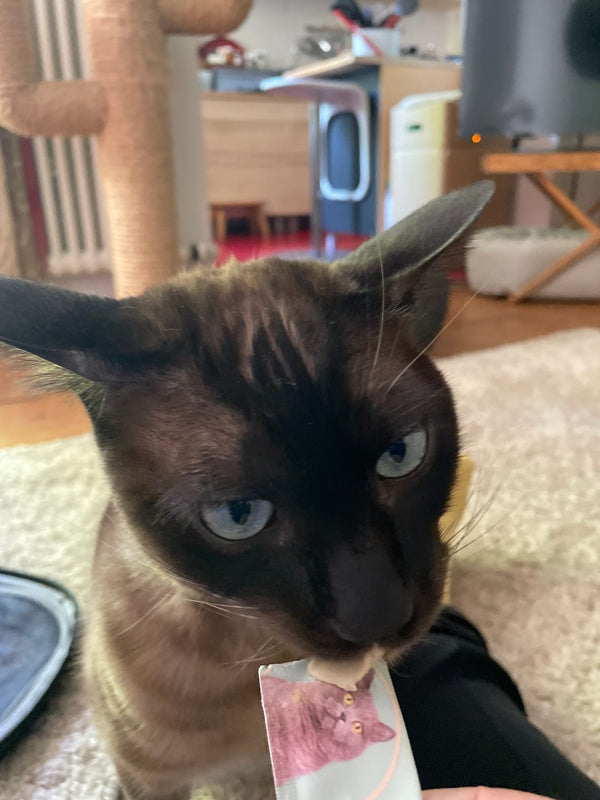

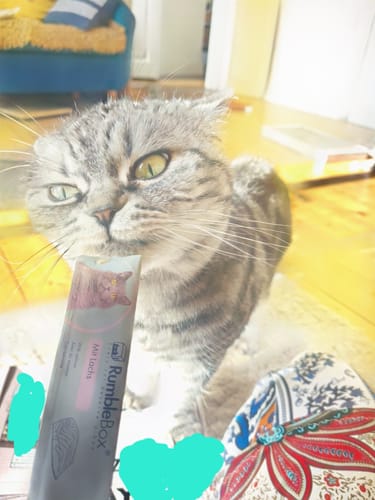
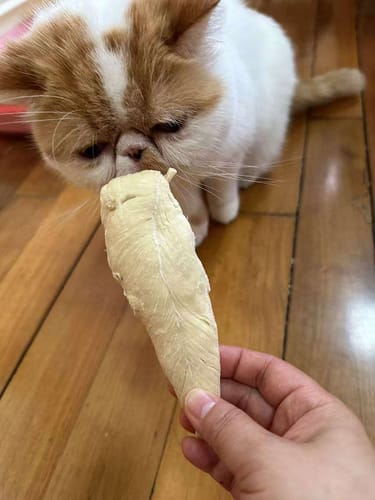
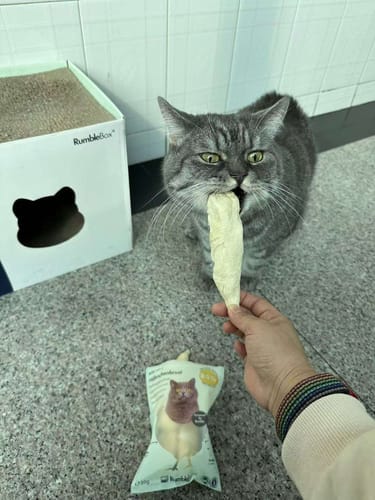
Over 2,500 cats have already switched to healthy snacks!
💚





100% Duck Breast Monoprotein 50g
Description
FREEZE-DRIED CAT SNACKS: 100% DUCK BREAST – NATURAL & NUTRITIOUS
Our freeze-dried cat snacks made from 100% duck breast are the perfect choice for cats who love pure meat snacks. The extra-large pieces are ideal for cats who like to bite hard—at the same time, they encourage their natural chewing instinct and support dental care.
Whether as a daily reward, monoprotein treat for cats or high-quality dried duck breast for cats with special needs – this freeze-dried cat snack stands for species-appropriate nutrition without compromise.
WHY OUR DUCK BREAST SNACKS ARE CONVINCING
- 100% natural : Pure duck breast – no grains, sugar or additives.
- Large pieces for extra enjoyment : Each duck breast is approx. 10 cm long, ideal for enjoyable chewing.
- Fresh meat : Direct from the farm – each 50g pack contains approximately 250g of fresh duck breast.
- Rich in nutrients : High-quality protein and valuable fatty acids for a shiny coat and strong muscles.
- Healthy teeth : The solid pieces promote chewing and support dental care.
- Monoprotein and well tolerated : Unprocessed duck breast for a healthy, species-appropriate diet.
PERFECT FOR ALLERGIC CATS AND SPECIAL NEEDS
Our freeze-dried cat snacks are not only delicious but also extremely well-tolerated. They are ideal as healthy treats for cats or as food for cats with allergies.