Are bird of paradise plants toxic to cats? What cat owners really need to know
Are Strelitzias toxic to cats – many cat owners type these four words into their phones the very moment their cat starts chewing on a Strelitzia leaf. In short: Yes, the Strelitzia counts as a plant that is toxic to cats, but it falls into the rather harmless category—mildly to moderately toxic, depending on the part of the plant and the amount ingested. Fatal poisoning from a few bites of a leaf is the absolute exception. Nevertheless, it is worth paying close attention, because "mildly toxic" does not mean "completely harmless."
Are Strelitzias toxic to cats – the quick answer first
For those in a hurry: The classic indoor Strelitzia (Strelitzia reginae, also known as the bird of paradise flower) is mildly to moderately toxic to cats. The Swiss plant experts at feey explicitly classify it as "mildly toxic" and note that gastrointestinal distress and vomiting only occur "if a sufficiently large quantity is consumed" (feey-pflanzen.de). A nibbled leaf therefore usually lands in the "unpleasant" category, not "life-threatening."
This article is for everyone living under the same roof as a Strelitzia and at least one curious cat—and for those currently considering bringing the plant into their living room. I will go through how toxic it really is, how to recognize poisoning, what to do in an emergency, and how to keep the risk low from the start without having to banish the entire plant from your home.
How toxic is the Strelitzia really for cats?
Things get a bit botanical here, because this is exactly where most misunderstandings arise. There are actually two completely different plants that are both commonly called "bird of paradise flower" in German.
"Mildly toxic" vs. "moderately toxic" – and why confusion is dangerous
The true indoor Strelitzia is Strelitzia reginae. The American animal welfare organization ASPCA explicitly classifies this as "less toxic"—significantly more harmless. A fascinating detail in their database is the warning that the Strelitzia should not be confused with the much more toxic Caesalpinia gilliesii, which is also called "bird of paradise" and may contain hydrogen cyanide compounds (ASPCA). Those who stumble upon horror stories online often have the wrong plant. For the Strelitzia you have in your pot, the general rule is: weakly toxic.
My personal assessment after cross-referencing several poisonous plant databases: The Strelitzia is in a completely different league than lilies (life-threatening to cats; even pollen or water from the vase can destroy the kidneys) or sago palms. With a Strelitzia, we are talking about a stomachache, not an intensive care unit.
Which plant parts are the most dangerous
Not every part of the plant is equally problematic. The highest concentration of irritants is found in the flowers, seeds, and fruits. The leaves, which cats are most likely to nibble on, are comparatively less critical—which fortunately de-escalates the situation, as most indoor Strelitzias rarely bloom and even more rarely form seeds. Nevertheless, if there are seeds around, keep them out of reach.
The toxins briefly explained
The responsible agents are irritant compounds in the plant that irritate the mucous membranes in the mouth and gastrointestinal tract. This explains the typical signs: drooling, gagging, and nausea. It is not systemic poisoning with organ damage like with the highly toxic varieties, but a local irritant reaction. Those who want to know the exact details can find reliable classifications in veterinary poisonous plant databases—such as the German Poison Control Center or the aforementioned ASPCA poisonous plant list.
Symptoms of Strelitzia poisoning in cats
The signs are rarely dramatic, but they are present, and you should be aware of them instead of wondering why your cat is suddenly smacking its lips strangely.
Typical signs
- Vomiting – often the first and most obvious signal
- Diarrhea or soft stool
- Increased drooling, sometimes with small smacking or gagging motions
- Loss of appetite and a cat that withdraws
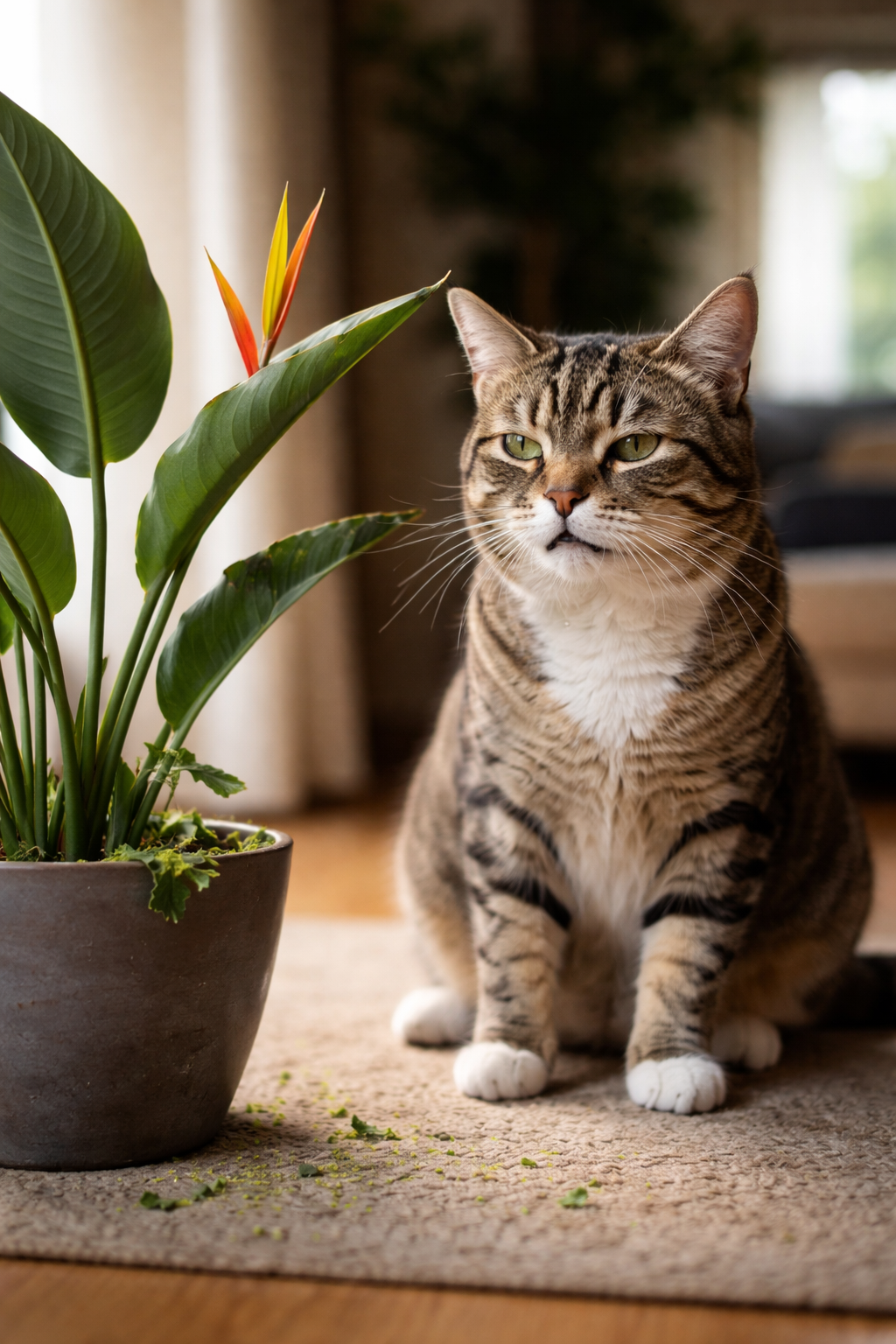
This aligns with what veterinarians and animal welfare organizations generally describe regarding irritant houseplants: increased salivation, vomiting, diarrhea (German Animal Welfare Federation).
When symptoms appear and how long they last
With a local irritation, it usually happens quickly—the cat often reacts shortly after nibbling with drooling or gagging. Gastrointestinal symptoms can persist for a few hours and usually subside on their own with small amounts once the plant material is expelled.
When it's harmless – and when it becomes an emergency
Honestly: One-off vomiting after a leaf bite, followed by a cat that drinks, is lively and eats again—that is no drama. I become alert if:
- the vomiting or diarrhea does not stop or recurs over hours,
- the cat becomes lethargic, walks unsteadily, or hides away,
- signs of breathing difficulties, tremors, or severe weakness appear,
- large quantities were eaten—especially flowers or seeds,
- it affects a young, elderly, or chronically ill animal.
In all these cases: do not wait, but act. And honestly—if you are unsure, a call to the poison control center is always cheaper than having a guilty conscience.
First aid: What to do if the cat has nibbled on the Strelitzia?
First of all: stay calm. Panic does not help the cat.
Immediate measures step-by-step
- Remove plant remains. Remove visible leaf or flower pieces from the cat's mouth, provided it allows you to do so.
- Check the mouth carefully. See if remains are stuck or if the mucous membrane looks irritated.
- Allow the mouth to be rinsed – offer fresh water, which dilutes irritants.
- Secure the plant. Place the Strelitzia out of reach immediately so that the cat doesn't take a second attempt.
- Observe the cat. Keep an eye on behavior, breathing, and the frequency of vomiting.
What you should NOT do
Please do not induce vomiting on your own—no saline solutions, no home remedies from the internet. This often does more damage to cats than the plant itself. Also, no milk "to calm the stomach" and no medications from your home cabinet. When in doubt: keep your hands off, pick up the phone.
Preparing correctly for the vet visit
When you call or go to the clinic, make the vet's job easier. Three pieces of information are helpful: the plant name (preferably "Strelitzia reginae," or a photo of the plant), the estimated quantity, and the time of nibbling. Feel free to bring a torn-off leaf piece or a mobile phone photo—that speeds up the assessment significantly.
Minimizing risk: Strelitzia and cat under one roof
The good news for plant people: You don't have to choose between a Strelitzia and a cat. You just need to arrange things more intelligently.
Placing the plant out of reach
Strelitzias grow large and are top-heavy—they are well-suited for spots that are hard for cats to reach. High shelves, wall mounts, or plant stands away from jump routes. If you like, you can keep sensitive specimens behind glass (such as in a closed, terrarium-like structure). Practical tip from interior design editors: Position plants so they are not on the cat's usual climbing route—inspiration for this is provided by interior magazines like Schöner Wohnen.
Creating a cat-proof home
Plant lovers don't have to capitulate. It helps to consistently move toxic plants higher up and leave only harmless items at the cat's eye level. A simple rule of thumb: What the cat can reach easily should be non-toxic. Consultation pages from plant retailers like Pflanzen-Kölle offer good overviews of which species fit into a household.
Distraction instead of prohibition
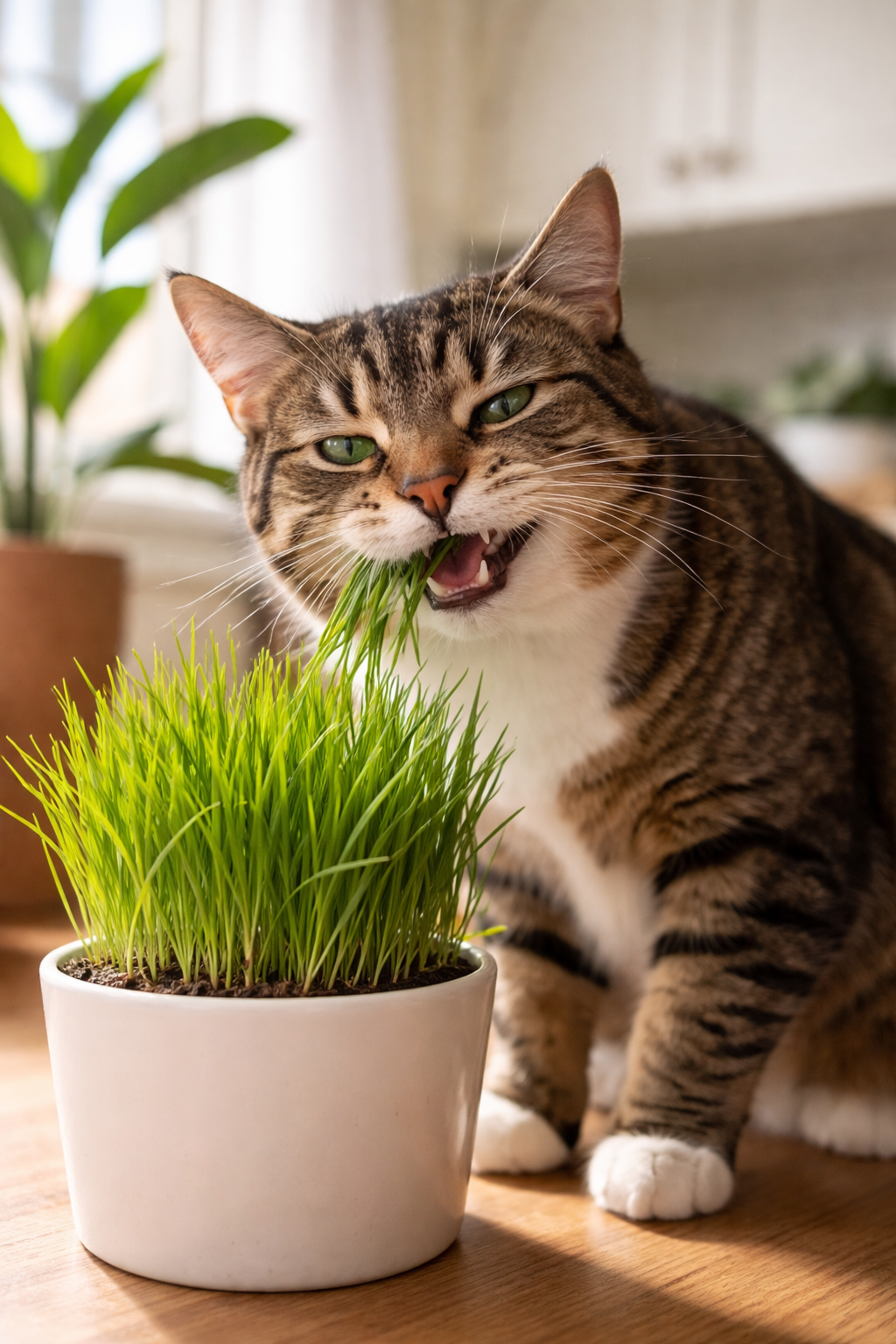
Here is the point many overlook: A cat that nibbles on plants is rarely "naughty." It is usually looking for something—activity, fiber structure to chew on, or sometimes just attention. Anyone who just shouts "No!" is treating the symptom, not the trigger. It is smarter to provide the cat with an allowed substitute: cat grass to chew on, more playtime, interactive feeding—and safe snacks that satisfy the need to chew and snack without irritating the stomach.
Offering healthy, safe snack alternatives
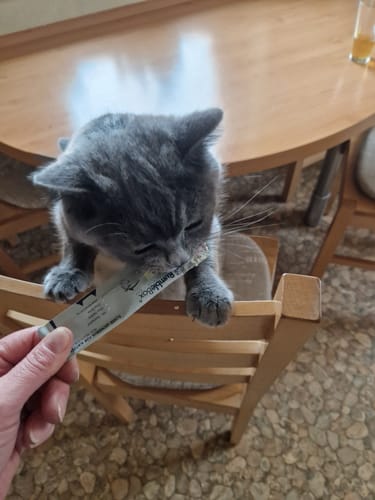
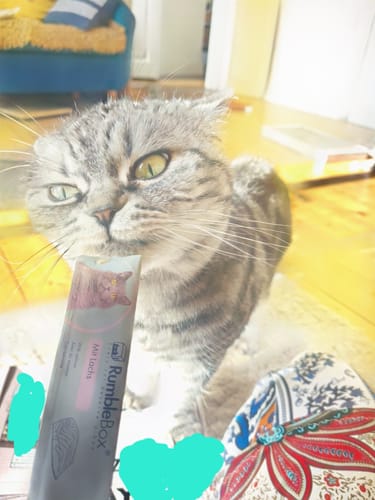
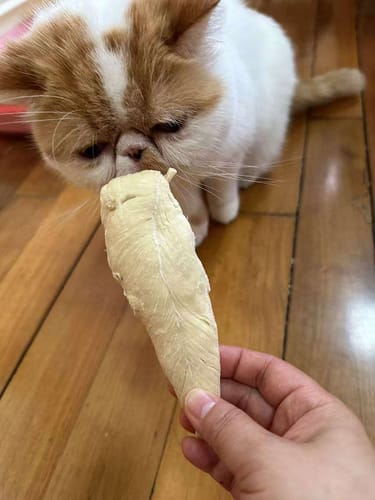
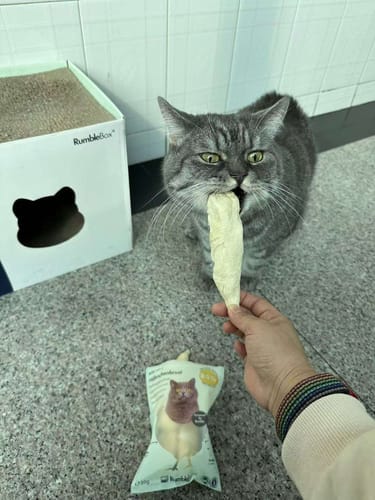
This is exactly what RumbleBox is for. The idea behind it is simple: cats are carnivores, so their snacks should also consist of real meat—not highly processed stuff. The freeze-dried snacks consist of 100% meat (e.g., pure chicken breast), without sugar, grain, or artificial colors or preservatives. This is particularly relevant for sensitive stomachs: according to the company, about 95% of cats do not react sensitively to the ingredients. A cat that gets a satisfying, safe chewing substitute simply has fewer reasons to test how plants taste on the Strelitzia.
Cat-friendly alternatives to the Strelitzia
If constant high-up placement is too tedious for you, there are plants you can place at cat level without worry.
Non-toxic houseplants for cat households
- Spider plant – robust, easy to care for, considered non-toxic (cats still like to nibble on it, which is okay).
- Cat grass – intended as bait, it distracts from the rest of the plant collection.
- Indoor bamboo, Calathea, and some palm species are also considered cat-friendly.
Overviews of cat-safe assortments can be found at plant suppliers like feey—practical if you are looking specifically for safe species.
Table: Toxic vs. non-toxic plants at a glance
| Avoid (toxic to cats) | Safe (non-toxic) |
|---|---|
| Strelitzia / Bird of paradise (mildly toxic) | Spider plant |
| Lilies (highly toxic!) | Cat grass |
| Devil's ivy | Calathea |
| Dieffenbachia | Indoor bamboo |
| Sago palm | Kentia palm |
Important: Lilies are a different kettle of fish than the Strelitzia. While the Strelitzia at most upsets the stomach, lilies can be fatal for cats. Please do not lump them together.
Those who also want to solve the snacking issue can find further guides to cat life as well as safe snacks—such as the Lick & Snack sampler box—in the RumbleBox shop.
Frequently asked questions (FAQ)
Is the Strelitzia fatal for cats?
As a rule, no. Strelitzia reginae is considered mildly to moderately toxic and is even classified as "less toxic" by the ASPCA. Small amounts usually only cause gastrointestinal upset. Fatal cases are a rare exception—but caution is better.
Are all Strelitzia species equally toxic?
The common indoor Strelitzias (reginae and the large nicolai) fall into the "mildly toxic" range. You should be careful about confusion with Caesalpinia gilliesii, which is also called "bird of paradise" but is significantly more toxic. When in doubt: check the botanical name.
Does cat grass help against nibbling on plants?
Often, yes. Many cats nibble out of a need for fiber or for entertainment. Accessible cat grass diverts part of this behavior away from the rest of the plant collection. It is not a panacea—but it is a good lure.
Which snacks are a safe reward for my cat?
Snacks without sugar, grain, and unnecessary additives are the safe choice, especially for sensitive stomachs. Pure, freeze-dried meat snacks like those from RumbleBox consist of 100% meat and are well-suited as a harmless reward—and as a distraction from the plant.
Conclusion: Better safe than sorry
Is the Strelitzia toxic to cats? Yes, but within manageable limits. Small amounts are rarely life-threatening, but are primarily unpleasant—drooling, maybe vomiting, an upset stomach. That is no reason to panic, but a good reason to take precautions. Place the plant high up, observe your cat, keep emergency numbers handy, and give your cat something allowed to snack on.My advice after all this: Solve the nibbling problem at the root, not the symptom. A cat that gets a safe, healthy chewing substitute is much more likely to leave the plant alone. The natural, grain- and sugar-free snacks from RumbleBox are intended for exactly that—stress-free, healthy snacking moments where you don't have to worry about what your cat is currently munching on.

Thank you for reading this far – it really means a lot to us! We hope you found something useful and maybe your cat is already looking forward to a little something extra. See you soon and lots of purrs!
By the way
Many cat owners pay close attention to the ingredients in their cat's main food , but often forget about treats .
Snacks often contain sugar, grains and artificial additives that can be harmful to health in the long run.
Anyone who truly wants to feed their cat a completely healthy diet should also rely on natural ingredients here:
Hypoallergenic treats without additives – naturally from RumbleBox. Perfect as a reward, during training, or simply as a snack.
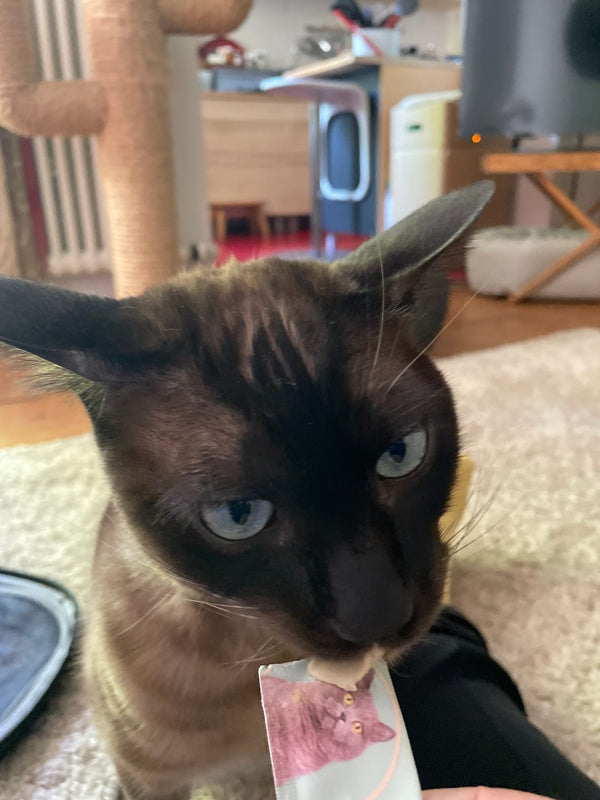
Over 2,500 cats have already switched to healthy snacks!
💚